Zone pricing in retail: what it is, and what three stores of one chain actually charge
Zone pricing is when a chain charges different prices for the same item in different groups of stores. Most explanations stop at the definition. We read the same items at three stores of one chain in New York, Chicago and Los Angeles on the same night: 378 of 534 carried a different price somewhere, with a median gap of 9.3%. At a second chain in the same three cities, all 833 items had one price.
Zone pricing is when a retail chain groups its stores into zones and charges a different price for the same item in each zone. A zone can be as large as a region or as small as one store. Chains do it because competition, costs and what customers will pay are local, and a single national price leaves money on the table in some markets and loses the sale in others.
That is the definition every glossary gives. What the glossaries leave out is what it looks like on a shelf, and how you would know whether the competitor across the street does it. So we read two chains, three cities each, on the same night.
What zone pricing looks like on the shelf
On September 17, 2026, Lightfeed read the beauty and personal care shelf at three Target stores: Chelsea in New York, Streeterville in Chicago and Westwood in Los Angeles. 534 items were listed at all three. We compared the regular price each store published, before promotions.
- 378 of the 534 items (71%) had a different price in at least one store.
- 259 items had three different prices, one per store. 119 had two. Only 156 had one price everywhere.
- Among the items that differed, the median gap between the cheapest and the dearest store was 9.3%. For 164 items the gap was 10% or more, and for 46 it was 20% or more.
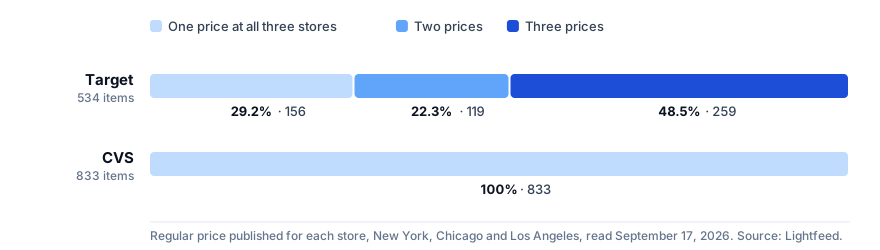
The same night we read three CVS stores in the same three cities: Chelsea, River North and Westwood. 833 items were listed at all three, and all 833 had the same price.
| Target | CVS | |
|---|---|---|
| Stores read | Chelsea NY, Streeterville IL, Westwood CA | Chelsea NY, River North IL, Westwood CA |
| Items listed at all three stores | 534 | 833 |
| Items with one price everywhere | 156 (29%) | 833 (100%) |
| Items with two prices | 119 (22%) | 0 |
| Items with three prices | 259 (49%) | 0 |
| Median gap, cheapest to dearest store | 9.3% | none |
Same category, same cities, same night. One chain prices by store and the other holds a national price online. Neither is unusual. Target has said as much: in a statement to CBS Chicago in May 2024 it said prices "occasionally vary between stores, or between stores and Target.com," based on "store inventory levels, local promotions or to ensure we offer competitive pricing with nearby retailers."
Six items, three prices
| Item | Chelsea, New York | Streeterville, Chicago | Westwood, Los Angeles |
|---|---|---|---|
| Maybelline Lash Sensational Sky High mascara, washable | $13.89 | $10.89 | $13.89 |
| CeraVe Brightening Vitamin C Cleanser, 8 fl oz | $20.99 | $16.19 | $16.49 |
| Neutrogena Hydro Boost City Shield SPF 25, 1.7 oz | $22.49 | $19.99 | $25.49 |
| La Roche-Posay Anthelios Melt-In Milk SPF 60, 3 fl oz | $39.49 | $30.99 | $31.99 |
| Naturium Multi-Peptide Serum, 1 fl oz | $32.49 | $24.99 | $24.99 |
| La Roche-Posay Anthelios Clear Skin SPF 60, 1.7 fl oz | $27.49 | $26.99 | $20.99 |
Regular prices published by target.com for each store, September 17, 2026.
The expensive store is not expensive on everything
Add up all 534 items and the basket cost $8,489 in Chelsea, $8,292 in Westwood and $8,093 in Streeterville. Chelsea was 4.9% above Streeterville and Westwood 2.5% above.
But the ranking does not hold item by item. Chelsea was the single most expensive store on 232 items. Westwood was on 46, and Streeterville, the cheapest basket, was still the most expensive store on 13. The last row of the table above is one of them in reverse: a sunscreen that costs $6.50 less in Los Angeles than in New York.
This is why a rule of thumb like "add 5% for Manhattan" does not reproduce a zoned competitor's prices. The zone sets a price list, and the list is tuned item by item.
Zones follow the brand as well as the map
Inside one chain, how local the price is depends on whose product it is.
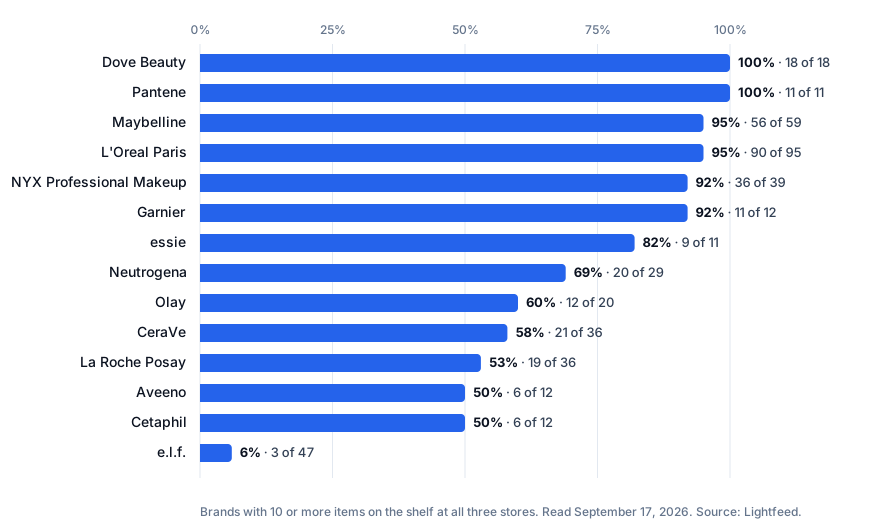
At Target, 90 of 95 L'Oréal Paris items and 56 of 59 Maybelline items were priced differently by store. CeraVe and La Roche-Posay sat near half. And 44 of 47 e.l.f. items had one price in all three cities.
We can see the pattern but not the reason; it could be the brand's pricing policy, the retailer's category strategy, or both. The practical point stands either way: sampling one brand to decide whether a competitor zones can give you the wrong answer. Sample across brands.
One more detail: 41 of the 534 items carried a promotion label that night, and each of the 41 carried it at all three stores. The promotions were national. The base prices under them were local.
What the research says about zones
Two studies are worth knowing, because they point in different directions and both are right.
Zones are usually much bigger than markets. Brian Adams and Kevin Williams studied Home Depot and Lowe's in Zone Pricing in Retail Oligopoly (American Economic Journal: Microeconomics, 2019). They found both chains set prices uniformly across zones "much larger than local markets," while the highest price for an identical good across the country could be as much as three times the lowest. Their model suggests coarse zones soften competition where the two chains meet and shield rural shoppers from the higher prices a local monopoly could charge.
Many chains barely zone at all. Stefano DellaVigna and Matthew Gentzkow, in Uniform Pricing in U.S. Retail Chains (Quarterly Journal of Economics, 2019), found that most US food, drugstore and mass-merchandise chains charged nearly uniform prices across stores despite wide differences in local income and competition, and estimated that the median chain gave up about $16 million a year in profit by doing so.
Our two reads fit both findings. CVS, a drugstore chain, was uniform. Target in 2026 was not, at least in beauty. The scanner data behind the second study is more than a decade old, and store-level price lists have become much cheaper to run since. What a given competitor does today is an empirical question with a cheap answer.
A zone you can see: Tractor Supply
Some chains make the zone explicit. Tractor Supply's website assigns every store a numbered price zone. On November 5, 2026 we read a few items at stores in three of them: Kingsville, Texas; Enola, Pennsylvania; and Monroe, Michigan.
| Item | Kingsville TX | Enola PA | Monroe MI |
|---|---|---|---|
| Purina Layena+ Omega-3 layer feed, 40 lb (list / sale) | $25.99 / $23.99 | $25.99 / $23.99 | $24.49 / $22.49 |
| Purina Layena+ Omega-3 layer feed, 10 lb (list / sale) | $12.99 / $11.99 | $12.99 / $11.99 | $11.99 / $10.99 |
| DeWalt DCD771C2 drill kit | $99.99 | $99.99 | not read |
Texas and Pennsylvania, about 1,500 miles apart, shared every price we saw. Michigan was lower on feed. That is the Adams and Williams pattern: zones that have little to do with distance. It is a small sample, a handful of items, and we would not draw the zone map from it.
What zone pricing does to a competitive price index
Most pricing teams report a competitive price index: your price over the competitor's price, averaged across matched items. If the competitor zones and you feed the index one price per item, three things go wrong.
- The level is wrong. Against Target, the same basket was 4.9% apart between two stores. An index of 100 against one store is roughly 95 or 105 against the other, and no price of yours changed.
- The item calls are wrong. With a median gap of 9.3% on the items that differ, a product you believe is at parity can be far out of band at the store your customer actually compares you with.
- The trend is wrong. If the "national" price is whatever store the data vendor happened to read, a change of store looks like a competitor price move.
The fix is to read the competitor at the stores that compete with yours and index each of your zones against its real neighbors. Where a competitor prices nationally, as CVS did here, one read is enough and it would be a waste to buy more.
How to map a competitor's price zones
You do not need their zone file. You need the same items read at several of their stores on the same day.
- Pick 20 to 50 items that are stable, branded and sold in every store. Spread them across brands and categories.
- Pick stores that differ in ways zones usually follow: a dense urban store, a suburban one, a rural one, a store next to a discounter, and stores in different states or provinces.
- Read every item at every store on the same day, regular price and promotional price separately.
- Group stores whose price lists match. Identical lists are one zone. If nothing differs, the chain prices nationally in that category, and you can stop.
- Assign each of your stores the competitor store, or zone, it actually faces, and build the index per zone.
- Repeat a few times a year. Zones are redrawn, and new stores are often priced apart from old ones.
This is the first thing Lightfeed's store-level price monitoring does with a new competitor: it reads your items at the stores you name, so the index for each of your zones is built on the prices your shoppers see. Brands use the same read the other way round, to see their own shelf price at every retailer and store.
How we counted
Each store's listing was read from the retailer's own website with that store selected, on September 17, 2026 between 01:33 and 07:36 UTC, as part of a public demo run on a beauty catalog. An item counts when the same retailer product id was returned at all three stores. The price compared is the regular price for that store, before any promotion. The Target stores are Chelsea 23rd and 8th (New York), Chicago Streeterville and LA Westwood; the CVS stores are Chelsea (New York), River North (Chicago) and Westwood (Los Angeles).
Three limits. The read is one category, beauty and personal care, and other categories may be zoned more or less. It is three stores per chain in three different metros, so it shows that prices differ between cities and says nothing about stores within one city. And a price published online for a store is the retailer's stated price for that store, not a photograph of the shelf tag, and a chain can price differently in the aisle than on its website. The Tractor Supply prices were read on November 5, 2026.
Frequently asked questions
What is zone pricing in retail?
What is an example of zone pricing?
Does Target charge different prices at different stores?
Do all retail chains use zone pricing?
Is zone pricing legal?
How do you find a competitor's price zones?
Sources
- Adams and Williams, Zone Pricing in Retail Oligopoly, American Economic Journal: Microeconomics 11(1), 2019, pages 124 to 156
- American Economic Association research highlight on the same paper, March 6, 2019
- DellaVigna and Gentzkow, Uniform Pricing in U.S. Retail Chains, Quarterly Journal of Economics 134(4), 2019, pages 2011 to 2084
- CBS Chicago, Why big chain store prices can vary from location to location in the Chicago area, May 16, 2024 (statements from Target, Walmart and Walgreens)